Stop prompting, start delegating—meet the digital coworkers executing multi-step tasks while you focus on strategy.
For the past three years, interacting with artificial intelligence felt a lot like managing an eager but forgetful intern. You typed a prompt, waited for a block of text, copied it into another window, corrected a hallucination, and prompted again. Every single step required your hands on the keyboard.
In late 2026, that era is officially in the rearview mirror. Welcome to the age of Agentic AI—systems designed not just to answer questions, but to plan, execute, verify, and complete multi-step goals across your software ecosystem with minimal human intervention.
What Makes an AI “Agentic”?
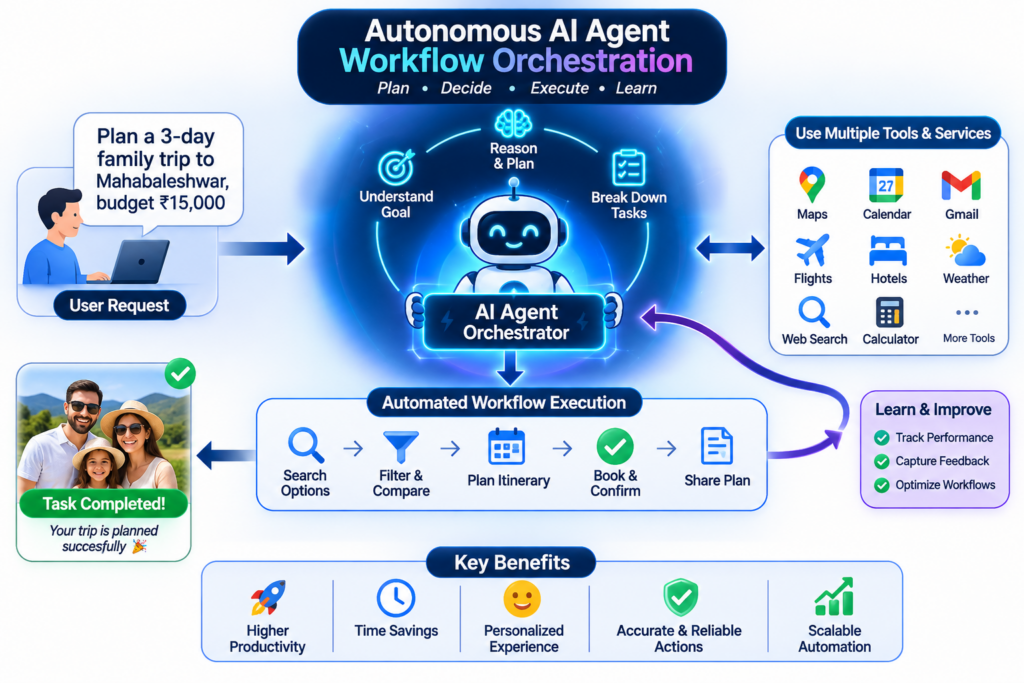
Traditional Large Language Models (LLMs) operate on a simple loop: Input ->Output. You ask for an email draft; it writes an email draft. It cannot open your inbox, check your calendar for conflicts, attach the latest Q4 spreadsheet, or hit send.
An autonomous AI agent, by contrast, combines reasoning models with tool-use capabilities, persistent memory, and self-correction loops. When you give an agent a high-level objective—such as “Prepare a competitive pricing brief for Thursday’s client call and share it with the marketing channel”—the agent breaks the goal down into sub-tasks:
- Research & Retrieval: It queries live web sources and scans your internal drive for existing pricing decks.
- Synthesis & Analysis: It structures a comparison matrix, flagging where your product undercuts or trails competitors.
- Verification: Before finalizing, a secondary critic-loop checks the numbers against source documents to eliminate errors.
- Execution: It formats the brief into a clean document and posts a summary directly to your team’s workspace.
Three Real-World Workflows Being Transformed Right Now
1. Customer Operations That Resolve, Not Just Deflect
First-generation support bots frustrated customers by regurgitating help-center links. Modern support agents integrate directly with billing, logistics, and CRM platforms. When a customer reports a damaged shipment, an agent can verify the order photo via multimodal vision, process a replacement label, update inventory records, and issue a personalized apology—resolving the ticket end-to-end in under forty seconds.
2. Software Engineering and Autonomous Security Patching
Developers no longer just use AI for autocomplete. Coding agents now monitor repositories continuously, reproduce bug reports in sandboxed environments, write unit tests, submit pull requests, and even scan for zero-day vulnerabilities before malicious actors can exploit them.
3. Personal Executive Assistance
On the consumer front, operating-system-level agents are turning smartphones and laptops into proactive companions. Instead of juggling five travel apps, you can instruct your device to monitor flight delays, rebook a dinner reservation if your plane is pushed back by two hours, and notify your driver—all automatically.
The Catch: Governance and Trust
With greater autonomy comes higher stakes. Enterprise leaders are discovering that giving an AI agent write-access to databases and financial tools requires strict guardrails. The biggest trend alongside agent deployment is Human-in-the-Loop (HITL) Governance. Smart workflows allow agents to draft, research, and stage actions freely, while requiring a one-tap human approval before irreversible steps like transferring funds, deleting records, or emailing external clients.
How to Prepare Your Workflow Today
You do not need an enterprise engineering budget to start benefiting from agentic workflows:
- Audit repetitive multi-tab tasks: Identify routines where you regularly move data between three or more apps (e.g., email ->spreadsheet -> project tracker).
- Start with “Draft-Only” autonomy: Configure AI tools to prepare deliverables automatically on a schedule, leaving final execution to your morning review.
- Prioritize clean documentation: Agents are only as reliable as the context they can read. Structured notes, clear file naming, and updated SOPs act as fuel for autonomous tools.
The shift from chatbots to agents marks the moment AI stops being a destination website you visit and becomes an invisible layer getting work done in the background. At GizVista, we will be testing and breaking down the best agentic tools every week—so you can spend less time managing software and more time building what matters.
For the past three years, interacting with artificial intelligence felt a lot like managing an eager but forgetful intern. You typed a prompt, waited for a block of text, copied it into another window, corrected a hallucination, and prompted again. Every single step required your hands on the keyboard.