The competitive standards of generative AI are changing. It’s becoming more important to break away from how plausible the question is to connect the actual system and how reliably it is to complete the results that the user wants through multiple steps. At the heart of this change is the Agentic AI, the autonomous AI agent.
Conclusion to check first
The key to Agentic AI is not ‘better answers’ but ‘the ability to reach the end of work’.
Search, telephone, data tracking, software manipulation, and payment are evolving to help AI plan and use tools to connect the work that people have done in the past by going back and forth between services. Companies, too, are starting to see real business metrics as more important than simple usage and model benchmarks, such as task completion rates, error rates, turnaround times, cost savings, and revenue contributions.
Key changes to be made in this article
- The role of AI is expanding from generating answers to actual actions and task completion.
- There are more and more cases of telephone, search, shopping, payment, computer operation, etc. connected to external systems.
- Gartner predicts that by the end of 2026, 40% of enterprise applications will include task-specific AI agents.
- On the contrary, it is expected that there will be fewer Agentic AI projects that will be discontinued due to cost and unclear value.
- Therefore, a company’s competitiveness is more likely to diverge from “how stable a task is to end up with a certain model” than on “what model is used.”
Table of Contents
- What makes Agentic AI different from traditional chatbots?
- Why is it possible to operate real-time telephone, payment, and computer?
- Why is the corporate AI market reshaping around ROI?
- What indicators should companies evaluate AI agents?
- Frequently Asked Questions
What makes Agentic AI different from traditional chatbots?
If an existing chatbot was a tool for generating answers to your questions, Agentic AI is more like a system that understands goals, plans for the tasks you need, and then uses external tools to produce real results.
Until now, the typical way to use generative AI has been relatively simple. When the user enters a question, the AI generates results such as text, images, and code. The person had to check the results again and enter them into another system or follow up.
In Agentic AI, this boundary changes. When the user presents an end goal, the AI divides the task into several stages, finds the information it needs, calls the API and database, manipulates the software interface, and moves on to the next step. If the interim result is different than expected, you can modify the plan or try again.
The chatbot answers, the agent goes on to the next action.
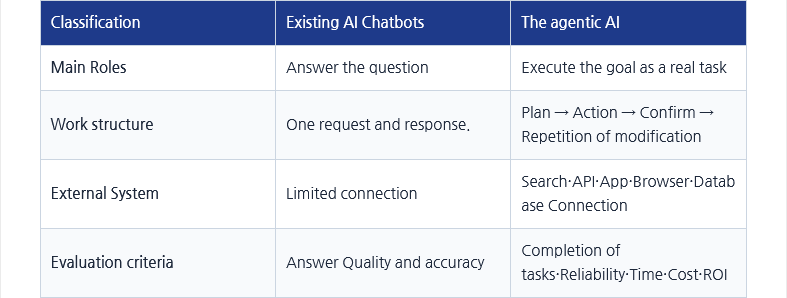
This difference seems small, but it’s quite big in business. For example, if the existing AI was at the level of clearing up the options for the “find a flight” request, the agent-type system could be extended to the approval stage or the booking system after checking, searching, comparing conditions.
After all, if generative AI was an information-producing tool, then Agentic AI is a process of evolving into a digital work practitioner.
Key Points
The essence of Agentic AI is not autonomy itself. The key is how secure and reliable the user’s desired goals can be converted into results within the actual system.
Why is it possible to operate real-time telephone, payment, and computer?
This is because the AI model has the ability to directly use external tools, and the scope of Agentic AI is expanding from information search to real-world work execution. The recent change has been that the connection to tool calls, computer usage, real-time voice, and payment systems is evolving at the same time, rather than simply increasing the inference score of the model.
AI to check prices and availability over the phone
Google has already introduced an agent feature in its search service that calls local vendors on behalf of users and checks prices and availability. For example, instead of calling multiple vendors to see the price of a particular service, AI collects information and organizes results.
The important change here is that AI doesn’t just summarize the information that already exists on the Internet. If the necessary information is not available on the web, it uses a new channel called the phone to get the information directly. This shows that AI’s scope of work is expanding from content understanding to real-world behavior.
Shopping goes from search to payment.
Agentic Commerce is a similar trend. Google is expanding its commerce structure that can not only explore and compare products, but also connect the purchase process within AI Mode and Gemini. In 2026, in some shopping environments in the U.S., the flow of searching and using Gemini to view products, reviewing orders, and making payments is being linked to the actual service.
If this structure is spread, the existing search process may also be different. In the past, if a user has clicked on search results and visited multiple shopping malls to compare prices, agents can take this process on their behalf and evolve into a form that only asks for the last approval.
Gemini, Meta, and xAI also move to “tools-enabled models”
Through the Gemini Enterprise Agent Platform, Google has expanded the environment for companies to build, operate, and manage autonomous agents, and the Gemini family continues to add features for long hours of work, computer use, code execution and tool connection.
Meta also describes the Muse Spark 1.1, which was unveiled in 2026, as a multimodal inference model focused on agent tasks. It emphasized the idea of planning back and forth between external applications and services, manipulating computer interfaces, and working with various sub-agents.
The Grok 4.5, released by xAI in July 2026, also featured coding, agentic tasks, and knowledge as its main areas of use. In the competition for enterprise AI, it means that not only “what the model knows”, but also “how long can a stable run of tasks” is becoming part of the competitiveness of the product.
The unit of AI competition is growing from ‘one answer’ to ‘the whole work process’.
| Why is the corporate AI market reshaping around ROI? |
For companies, how much more important it is to actually reduce the cost, time, and error of existing work than how smart AI is. The more the AI adoption moves from the experimental stage to the operational stage, the more the evaluation criteria will move from the technical benchmark to the business performance.
What does Gartner’s 40% outlook mean?
In its August 2025 projections, Gartner projected that the percentage of task-specific AI agent-mounted enterprise applications with less than 5 percent in 2025 will reach 40 percent by the end of 2026.
There is something to note here. The figure is not the current adoption rate that “40% of enterprise applications already use AI agents”, but the projection for the end of 2026. Therefore, it is appropriate to interpret it as an indicator of the direction that the market is expanding rapidly.
At the same time, more than 40% of projects can be discontinued.
There are more important numbers. Gartner predicts that more than 40 percent of Agentic AI projects will be canceled by the end of 2027, citing rising costs, unclear business value and insufficient risk controls.
Putting the two prospects together makes the direction of the market clearer. AI agent functions are rapidly disseminated, but the fact that they are equipped does not create economic value. This means that projects that reliably automate actual workflows and fail to prove cost-effectiveness are likely to be cleaned up.
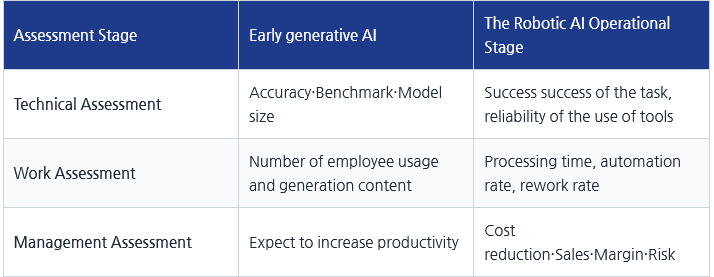
AI ROI can be greater in process redesign than personal productivity
It’s also a productivity boost for an employee to write a report twenty minutes quickly. However, in order to have a meaningful impact on the overall profit and loss of the company, this savings time must be linked to changes in the actual work process.
That’s why the agentic AI is in the spotlight here. Beyond simply creating documents quickly, there is the potential to automate the process itself from start to finish, such as order processing, customer contact resolution, data analysis, authorization requests, and system updates.
In a survey of AI ROI published by Google Cloud in 2026, organizations that are making AI investments highlighted the results of their measurable business, such as revenue, operational performance, and decision-making speed, as well as reducing costs. However, since specific findings cannot be applied equally to all companies, the actual ROI should take into account the type of work, cost of construction, accuracy and level of control.
The easy part to miss
The fact that Agentic AI reduces the number of clicks in a person does not automatically cause ROI. The total cost must be calculated, including the cost of using the model, the integration cost of the system, the cost of checking the error, and the cost of security and permission management.
| What indicators should companies evaluate AI agents? |
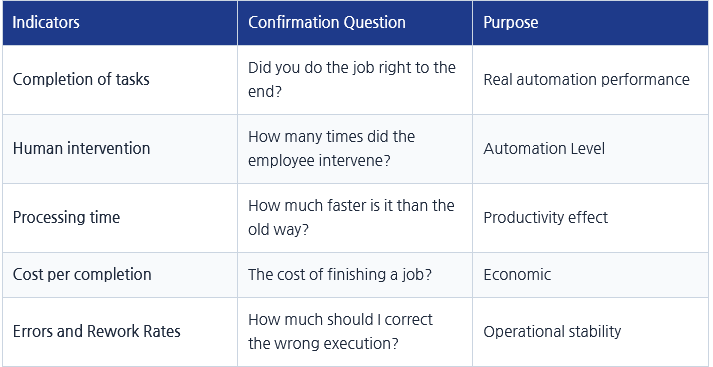
Enterprise AI agents should measure task completion rates, human intervention frequency, processing time, and errors and costs, rather than one model score. Because Agentic AI goes through several stages, the final result is correct, but it is difficult to determine operational stability.
1. The task completion rate
The most intuitive indicator is the percentage that actually finished the requested task. If it is automation of customer inquiry, you can see the percentage of customer problems solved, and if it is automation of work system, you can see the percentage of data viewed requested to reflect the system.
The definition of “complete” must be clearly defined. It’s just because you’ve moved to the last screen and got the exact results.
2. The Human Intervention Rate
It measures how often a person has to intervene while AI is performing its tasks. Even if the success rate is high, the automation effect can be limited if the employee has to review and modify the results every time.
3. Time-to-value and time-to-value
It’s also important to know how quickly you get results compared to what you’re doing. Google Cloud also explains that in the AI agent evaluation in the operational AI agent evaluation, it is necessary to look not only at the final output, but also with the reliability of the execution process, the friction that occurs in people to validate and modify the results, and the time it takes for the value to occur.
4. Cost per completed task
Agentic AI can call and retrieve models multiple times in one request, use search, API, database and external tools. Therefore, it is practical to calculate the total cost per completed task normally rather than the simple token price.
5. Errors, Permissions, and Audits Possibilities
When AI starts to act, the cost of mistakes increases. The wrong lines of answers, incorrect remittances, orders, and data corrections have completely different levels of risk. You need to be able to record why a tool was invoked, and important actions require a way of putting a person’s approval process in place.
The first question to look at in the introduction of a company
- Is it a work with high repetition frequency and clear results?
- Is it possible to connect data with the systems that AI needs to access?
- Can success and failure be judged objectively?
- Can I bring back an error when it occurs?
- What actions do people require approval?
- Can you measure the cost and revenue effect after automation?
| Frequently Asked Questions |
When understanding Agentic AI, it is important to look at the actual scope of work and operational indicators together rather than the expression of autonomy.
| What is Agentic AI? An Agentic AI is an AI system that plans tasks based on the goals laid out by the user and uses external tools such as search, API, and software to perform multiple steps. If existing chatbots mainly generate answers, Agentic AI is advancing towards executing real tasks to the end. |
| What is the biggest difference between an AI agent and an existing chatbot? The biggest difference is the range of action. Traditional chatbots are central to providing information to users’ questions, but AI agents can break down goals into different levels and use external systems to do their actual work. As a result, the evaluation criteria are expanded not only in quality, but also in the completion rate of the task, errors, processing time and cost. |
| What are the most important indicators for the introduction of a corporate AI agent? It is better to look at the task completion rate, the human intervention rate, processing time, and the cost and error and rework rate per completion than to see only one indicator. The key is how AI reliably ends its actual work and creates more economic value than traditional methods. |
| Is the adoption of AI agents increasing significantly in 2026? A rapid escalation is expected, but the outlook and current adoption rates must be distinguished. Gartner predicts that the percentage of task-specific AI agent-equipped enterprise applications with less than 5% in 2025 will reach 40% by the end of 2026. At the same time, more than 40 percent of the Agentic AI project could be discontinued by the end of 2027 due to costs and unclear business value. |
| Can Agentic AI fully automate all of its work? It’s hard to see that we can fully automate all of our tasks at this stage. AI that performs real-world actions can increase the cost of errors, such as incorrect orders or data corrections, so it is necessary to limit the authority according to work risks, and to have a person’s approval and execution history, and error recovery procedures at important stages. |